The Tobucksy County Newsletter is our official Society publication, bringing you regular updates on Society activities, events, and research alongside in-depth articles from Society members and guest writers. The Newsletter is a quarterly, digital publication, with print copies available upon request!
Vol. 37, No. 3 (Digital 2.3): July-September, 2026
Welcome back to the Tobucksy County Newsletter! This edition includes a review of recent Society events/programming, along with a an article researched by Society member Patsy Miller.
Current PCGHS Board
- President – David Beall
- Vice President – Adeline Whisenhunt
- Secretary – Julie Wolf
- Treasurer – Jim Young
- Members At-Large: Malinda Dobson, Paige McClain, Christina Thurber
Society Highlights July-September 2026

- Monday, July 27– Patsy Miller presents “Historic One-Room School Houses of Pittsburg County” at the McAlester Public Library.
- Tuesday, August 18 – The PCGHS holds open auditions for the 2026 True Crime Cemetery Tour.
- Monday, August 24 – David Beall presents “Exploring North McAlester Cemetery Tombstone Motifs and Symbols” at the McAlester Public Library.
- Tuesday, September 1 – PCGHS monthly meeting, featuring “McAlester Picturesquely Put,” presented by David Beall.

- Monday, September 28 – David Beall presents “McAlester Picturesquely Put” at McAlester Public Library.
Featured Article: Historic One-Room Schoolhouses of Pittsburg County, Part 1
Research by Patsy Miller
The idea of one-room schoolhouse goes back to the early 1800s, with them being most common in rural areas. Students of different ages and grades met in a single room, usually with only one teacher. We tend to think of this style as an American trend, but in reality, one-room schoolhouses appeared all over the world in areas too sparsely populated to support a larger school system.
In addition to educating children, local schoolhouses often became the focus for community life. The space was used for church services, community suppers, and celebrations. Thus, the schoolhouse provided a social life outside of one’s family.
One-room schoolhouses grew in number just after the end of the Civil War in 1865, as Americans began to support the idea that all students should be provided an education up to eighth grade, after which they could transfer to a nearby high school. In fact, the Oklahoma Constitution of 1907 included a plan for free public education for all children, and the government created the office of County Superintendent to oversee all schools in a given county.
Depictions from older movies or television shows often accurately portray the basic layout of the classroom: rows of desks; a cast iron stove in the center; a cloakroom at the rear or side where coats, boots, and packed lunches were stored. Across the front of the room, or perhaps along the sides, would be blackboards—sometimes proper chalkboards and sometimes simply boards painted black. Many students completed their work orally or via slates, a precursor to the iconic Big Chief tablets. Rural schools often had two terms—summer and winter—giving time for older children to be at home during the growing and harvesting seasons. It was only after 1900 that the nine-month term as we know it came into effect.
Early in my teaching career, I taught in what was called a “combined classroom”: four grades learning together. There was some skepticism, but the system worked well thanks to a long history of effective education in one-room settings. Students learned to work independently while waiting for their time with the teacher (some even listened in on other lessons to pick up additional learning), and older students were often called on to help with younger students.
As late as 1930, half of the nation’s school children lived in rural areas, with over half of the schools being one-room buildings. Documentation from the PCGHS library lists 102 county schools other than McAlester in 1930, with many of these being one-room systems. A selection of these are described here:
Vireton is not mentioned as a community in Oklahoma Place Names. However, the 1905 Choctaw Nation map includes a Vireton Post Office, also called “Simpson,” situated eight miles northeast of McAlester. The 1901 list of schools for this district of the Choctaw Nation lists Vireton School, with the local trustee being my grandfather, Osburne White, a full-blood Choctaw. I attended Vireton in my early years.

The above photograph, which I took in December of 2025, shows the step of the original schoolhouse, located about 13 miles northeast of McAlester. Newspaper accounts tell of the school being destroyed by a tornado on January 4, 1917. Of 29 people in the building at the time, 15 died, all children. 12 of the remaining 14 people were injured. Only three boards remained to mark where the school once stood.
The school was rebuilt half a mile away (pictured below). This was the location I attended, and I still remember my teacher, Ruby Murray, fondly. Visitors provided days of excitement for students, with one notable visit being from the county health nurse, Gladys Helterbrand, mother of Lucy Smith, a superintendent of McAlester Schools. The “Bible Ladies,” two women who traveled from school to school singing songs and presenting Scripture to children, were monthly visitors.

In 1957, a bill was passed which required an average daily attendance of 15 students. If a school’s enrollment dropped below that, the school would be annexed into another school district. Less than a decade later, Vireton closed in 1965, with students transferring to the Crowder school system. There were only two students enrolled at Vireton that year, including my brother. Today, the school building looks much the same, but has become a residential dwelling.
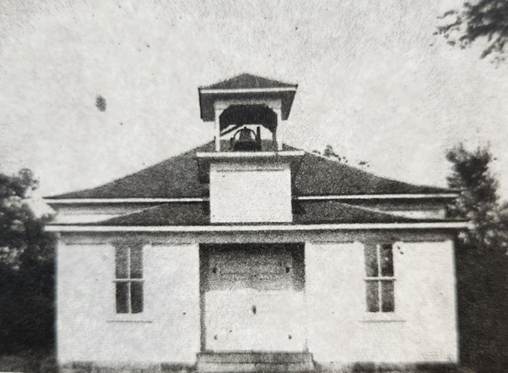
High Hill School was organized on January 11, 1908. The community of High Hill, settled a few years earlier, is located about 4 miles south of Bache. The original building (above) was used as both a church and schoolhouse, but later burned down. A new building (below) was constructed, which included a classic school bell. The bell is now owned by High Hill Baptist Church, which is located across the road from the school site. High Hill closed July 7, 1967, with students transferring to Haileyville. A former student at High Hill, Mr. Ray Pool, provided descriptions of the school’s amenities: a coal stove for heat; on-site well, coal house, and cellar; outside toilets; and the mentioned school bell, which rang at 7:50 in the morning and 4 in the afternoon every day. He also noted that each day began with a flag-raising and the Pledge of Allegiance, and the school would host a pie supper social to fund a yearly Christmas program (including gifts for the children). Mr. Pool later purchased the school site to build a residence, and his son-in-law had a historical marker made from an old school step.

Bugtussle School (pictured below) is perhaps most known for its association with Carl Albert, Speaker of the House of Representatives from 1971-1977 and one of Pittsburg County’s most celebrated former citizens. The school reportedly got its name due to the many bugs drawn to the schoolhouse during nighttime programs lit by lamplight. Around 1910, a teacher, Lottie Rose, worked to rename the school Flowery Mound, but the name never stuck in the minds of locals. Today, nothing is left of the school except its cellar. The Bugtussle Fire Department facilities now inhabit the site.

From the Editor: This article has been adapted from Patsy Miller’s presentation of the same name, given previously at the McAlester Public Library and at the May 2026 PCGHS meeting. Part 2 will appear in the next issue of the Tobucksy County Newsletter!